

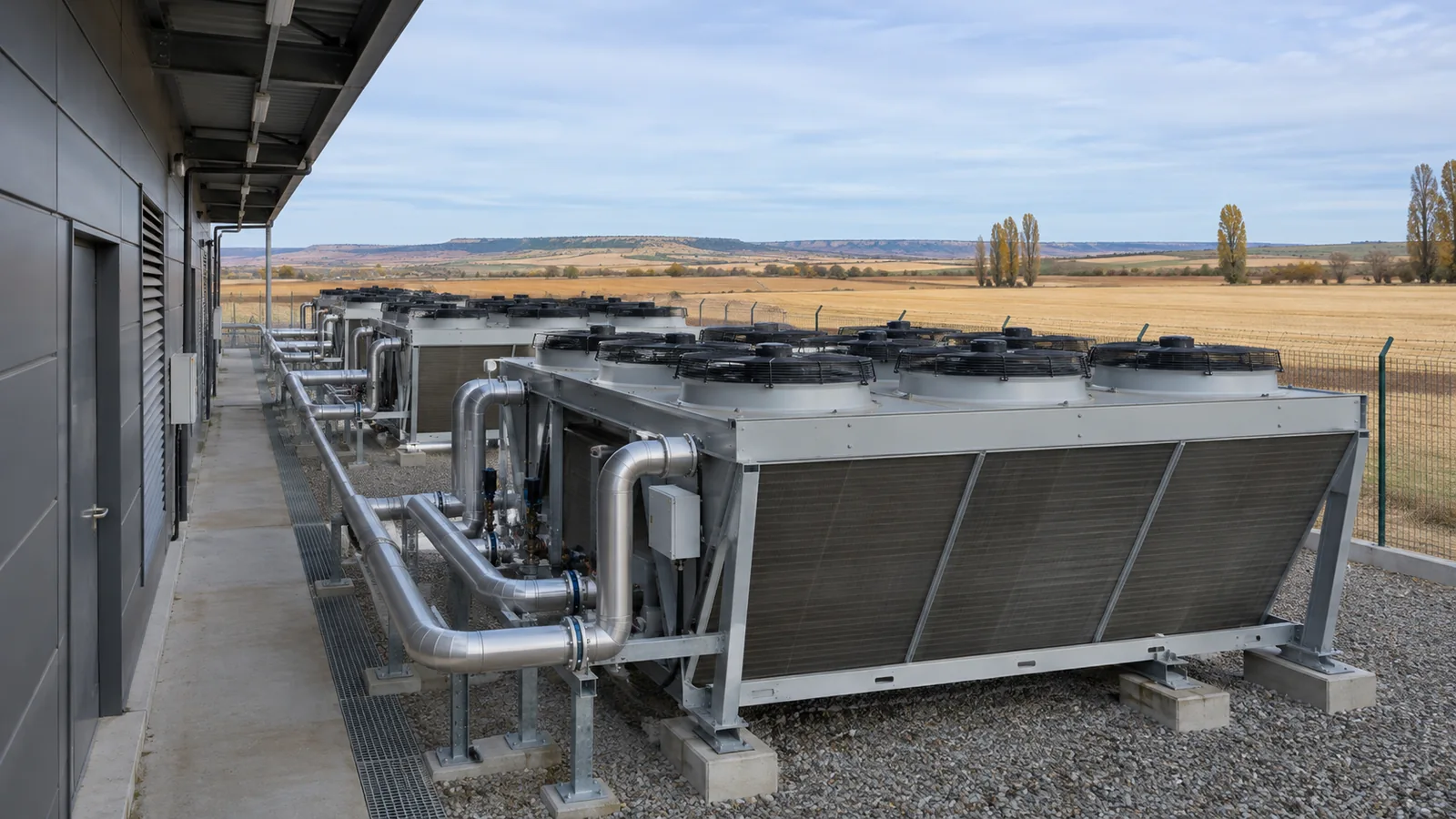
Three of the installations reviewed in Castile and León were already operating: the Caléndula supercomputer in León, the regional government’s data centre in Valladolid and a Telefónica node in the same city. In Soria, the Social Security data centre was still under construction in the latest update found. As of 13 November 2026, the AI campus proposed for Monfarracinos in Zamora, with 200 MW of IT capacity, was going through the approval process. Spanish Supercomputing Network · Telefónica · Regional government’s Monfarracinos project record
What is known about each facility
| Location and facility | Status | What the source confirms |
|---|---|---|
| León, SCAYLE | In service, with a move to new premises being prepared | Caléndula is a node of the Spanish Supercomputing Network. Its specification lists peak performance of 6.7 petaflops, a measure of floating-point operations per second. A contract to fit out the data centre at its new premises went out to tender in June 2026. Spanish Supercomputing Network · Procurement notice |
| Valladolid, regional government data centre | In service | The maintenance specification records that the centre began operating in 2016 at the former military hospital. This main data centre brought together IT services that had been spread across regional government sites. Regional government specification, pp. 3–5 |
| Valladolid, Telefónica node | In service | Telefónica confirmed activation on 24 June 2026. The facility is part of a network of 17 edge computing nodes that process data close to where it is generated. Telefónica |
| Soria, Social Security data centre | Under construction in September 2026 | Tecnalia studied the energy design of the Los Royales facility and reported that it was under construction on 30 September. The initial construction contract was awarded in 2023 for €71.66 million excluding VAT. The date of entry into service had yet to be confirmed. Tecnalia · Spanish official state gazette · Contract award documentation |
| Monfarracinos, Zamora | In the approval process | Edison Next Spain and FRV-X Renewable propose five buildings, each with 40 MW of IT capacity. The regional government describes an AI campus on the Zamora Norte industrial estate with its own electricity supply, designed to operate independently of the national grid. Its public participation portal lists 23 November 2026 as the deadline for comments. Regional government participation portal · Gazette of the Castile and León regional parliament |
| Segovia province, IGNIS and Acciona | Joint development announced | On 7 August 2026, IGNIS announced the joint development of a data centre with an adjacent solar power plant. The announcement did not specify the municipality, the centre’s capacity or an opening date. IGNIS |
If you need computing capacity in the region, start with the service you need. An edge node can reduce response times by processing data close to a factory or its users. A scientific centre such as SCAYLE offers high-performance computing and data services for research. A multi-building campus must secure power and cooling for each phase before it can make capacity available. Telefónica · Spanish Ministry of Science’s Caléndula profile
Where to check the available electricity supply
Castile and León generated 29,008 GWh of renewable electricity in 2025, accounting for 93.9% of its total generation, including self-consumption. This measures energy produced over a year. A facility running around the clock also needs to know how much power it can draw at any one time, at which point and from what date. Red Eléctrica publishes available demand capacity by transmission node and conducts a specific study for each application. Red Eléctrica’s regional electricity figures · Grid access methodology
In Segovia, IGNIS says two group companies pursued grid access and connection permits before formalising the joint development with Acciona. To know how much power the centre will receive and when it can use it, check the access conditions and the timetable for connecting it. IGNIS announcement
How the figures change from one building to a campus
The Monfarracinos proposal gives a starting point of 40 MW of IT equipment per building. Suppose the main supply is unavailable for four hours, the IT equipment remains at full load and cooling, losses and other services need another 25% of power. The last two columns show what a backup system covering the entire load would have to supply in this scenario. Gazette of the Castile and León regional parliament
| Scenario | Planned IT capacity | Total power in the example | Energy for four hours |
|---|---|---|---|
| One building | 40 MW | 50 MW | 200 MWh |
| Five buildings | 200 MW | 250 MW | 1,000 MWh |
For one building, 40 MW × 1.25 = 50 MW and 50 MW × 4 h = 200 MWh. That same amount of energy would last 48 minutes for the whole campus, provided the backup system could deliver the 250 MW assumed in the example. To assess a facility operating independently of the grid, check usable battery energy at the start of an interruption and how much power the generators can bring online in time. The four-hour interruption and 25% overhead are assumptions for this example.
How climate and fibre affect site selection
For 1981–2010, AEMET’s Soria station recorded a mean annual temperature of 11.0 °C and a mean daily maximum of 28.7 °C in July. The Social Security project plans to take advantage of favourable outside temperatures to reduce the load on mechanical cooling. For another site, estimate the hours in which outside air could be used and size the system for summer conditions. If the design uses water, its documentation should identify the source and demand during dry periods. River basin authority flood maps cover both the plot and access routes. AEMET · Tecnalia, cooling design · Duero River Basin Authority flood maps · Valinkey’s high-performance cooling guide
RedCAYLE connects research institutions and universities across Castile and León over a DWDM optical network, with links of up to 100 Gbps between campuses. For a commercial site, what matters is the connectivity offered to the particular building. If service must continue after a cable duct is cut, check the physical paths of both links and where they enter the property. Measure latency to the users as well, especially if the project offers real-time processing. RedCAYLE network infrastructure · TIA report on edge-node survivability. The guide to data centres in Spain compares the role of fibre and grid access in other regions.
What to look for in the next announcement
León and Valladolid offer examples of services already being delivered. In Soria, the next useful milestone is entry into service after construction. For announced campuses, look for the project record, the latest decision and the scope of the first phase. When a figure is given in megawatts, check whether it refers to IT equipment, supply to the whole building or backup power. That distinction lets you compare what each site could offer and when.