

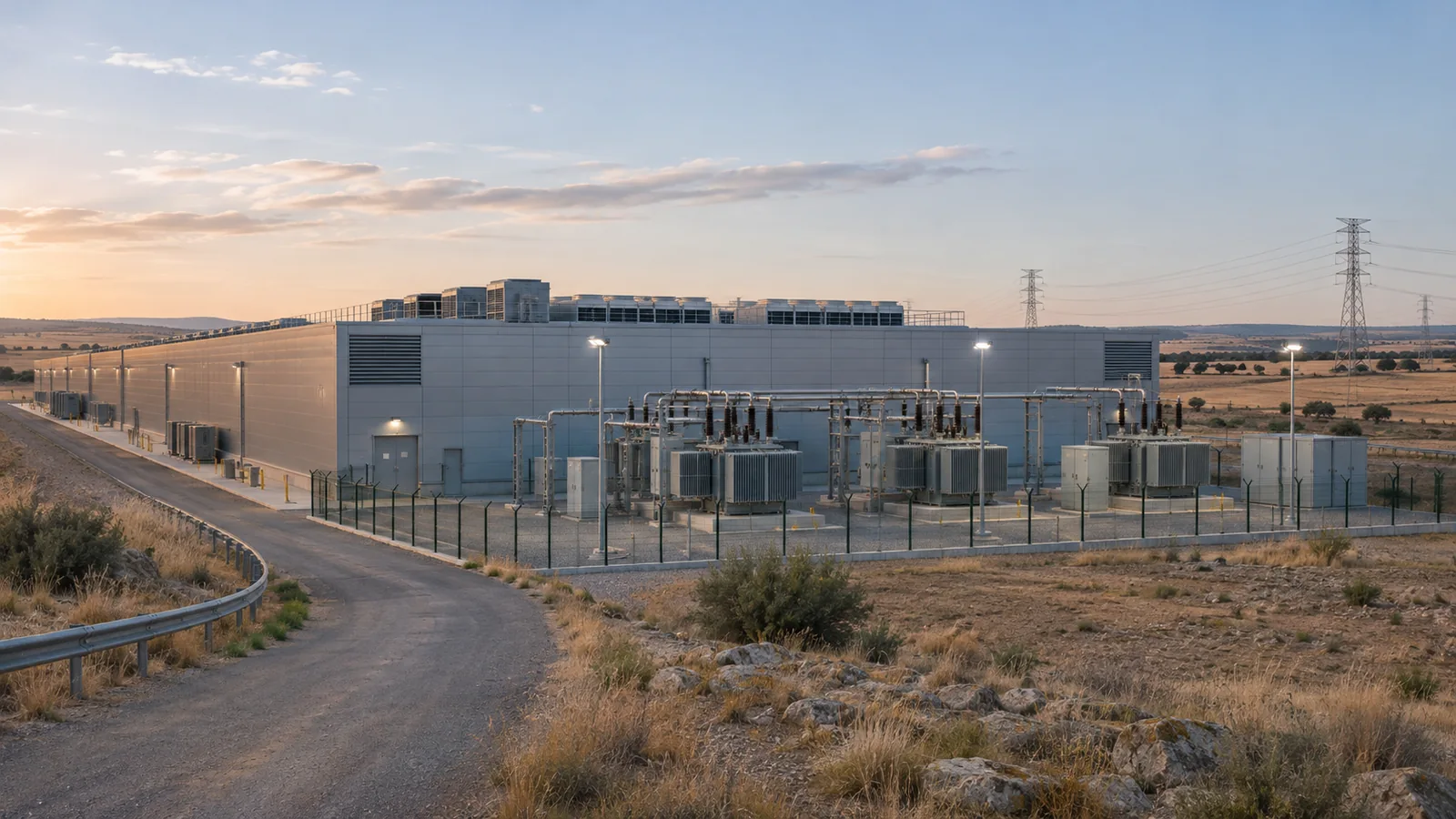
Madrid and Barcelona bring together customers, data centres and internet networks. Aragón is expanding the Spanish Amazon Web Services region, while Álava shows how much depends on the electricity grid. At its Bilbao-Arasur campus, MERLIN postponed expansions totalling 162 MW of IT capacity while it waits for grid connection infrastructure. These four cases show how proximity to users, fibre links and power supply affect where a centre is built and when it can open. DE-CIX · Amazon Web Services · MERLIN’s results filed with the CNMV
Figures checked on 13 November 2026.
Madrid and Barcelona bring operators and customers together
An internet exchange point lets telecom operators, cloud providers and other networks exchange traffic directly. This can shorten the path data travels and reduce response times. In October 2026, DE-CIX Madrid reported more than 220 connected networks at its exchange. DE-CIX has operated an exchange in Barcelona since 2021. MERLIN’s 12 November results listed its data centre in Barcelona’s Zona Franca as fully operational. DE-CIX · MERLIN’s results filed with the CNMV
Microsoft opened its Spain Central cloud region in the Madrid region on 11 June 2024. It spans three availability zones with independent power, cooling and networks. A single zone can contain several data centres. An application designed to run in more than one zone can keep serving users if one fails. Keeping zones near one another supports fast communication, while separating them physically reduces the chance of a single failure affecting several zones. Spain Central opening announcement · Azure regions
Aragón expands an operating cloud region
AWS opened its Spanish region in November 2022 with three availability zones. Aragón’s project records locate the initial facilities in Huesca, Villanueva de Gállego and El Burgo de Ebro and document the fibre network connecting them. One of the expansion sites in Villanueva de Gállego allows new facilities to join that network. In June 2026 the Government of Aragón approved part of the expansion, including an electricity substation in El Burgo de Ebro. AWS opening announcement · Cloud region project record · Initial expansion proceedings · June 2026 decision
According to Red Eléctrica, 82.4% of the electricity generated in Aragón in 2025 came from renewables, including self-consumption. A building expansion still depends on how much power the local grid can deliver, at which substation and from what date. In March 2026, Amazon raised its planned investment in expanding and supporting its Spanish infrastructure to €33.7 billion. This includes the €15.7 billion announced in its 2024 plan. Aragón electricity figures · Amazon’s announcement
Álava shows why the grid connection matters
The first Bilbao-Arasur building is in Rivabellosa, in the Arasur logistics park. MERLIN reported it as operational with 22 MW of IT capacity. The operator also reports connections from the campus to North America, Madrid, Barcelona and Lisbon. In Bizkaia, the Marea submarine cable runs from Virginia Beach to Sopelana and continues overland to the Telxius data centre in Derio. It illustrates how a submarine route reaches an inland facility. Bilbao-Arasur location · MERLIN presentation, p. 44 · Campus connectivity · Marea cable
Two power figures for Bilbao-Arasur 02
On page 45 of MERLIN’s October presentation, look for the BIO-ARA II column. The update filed with the Spanish securities regulator, the CNMV, on 12 November reports on the same building. The Basque official gazette identifies the project location and records the favourable environmental declaration published in January 2025. Official Gazette of the Basque Country
| What to check | What MERLIN reports |
|---|---|
| Location and building | Rivabellosa, in the municipality of Ribera Baja, Álava. Bilbao-Arasur 02. |
| Capacity for IT equipment | 48 MW of IT capacity for servers, networking and storage. |
| Planned electricity supply | 70 MW for the building. MERLIN says that it has been granted the capacity and expects the supply to be available after construction. |
| Latest reported milestone | The building was under construction and nearing completion. Handover was expected in December 2026. |
The calculation 70 − 48 = 22 MW gives the difference between two design figures. The building’s supply also powers cooling and covers losses in electricity distribution. To estimate actual non-IT energy consumption, subtract the energy measured at the IT equipment from total building energy over the same period. At this campus, MERLIN moved 162 MW of IT capacity from other expansions into its future development portfolio because of administrative delays affecting electrical infrastructure. Capacity had been granted, but the works needed to deliver it were outstanding. MERLIN presentation, p. 45 · MERLIN’s results filed with the CNMV · European Commission guidance on measuring energy efficiency
What grid plans and access permits tell us
On 12 November 2026, the Spanish government presented Congress with an electricity network plan through 2030. It proposed serving 9.3 GW of new data-centre demand out of 47 GW for all uses across transmission and distribution networks. That day the official state gazette, the BOE, published the strategic environmental declaration. The ministry described approval of the plan as a subsequent step. The figure represents the demand the proposed network works are intended to serve. MITECO · Strategic environmental declaration in the BOE
On 1 October 2026, Red Eléctrica’s transmission network register reported that data centres had been granted access for 6,329 MW. All of that capacity was still awaiting commissioning at the reporting date. The register covers transmission network requests. For distribution connections, consult the relevant distribution network operator. Red Eléctrica’s 1 October release
How to check a data-centre announcement near you
- Identify the municipality, developer and project stage. Search the regional official gazette by municipality and company. Look at whether the document records an announcement, environmental authorisation or a construction permit. For evidence that the facility serves customers, look for a commissioning date from its operator.
- Locate the electricity connection. The CNMC’s demand maps show grid nodes, the points at which installations connect to the network. Red Eléctrica separately publishes the status of transmission requests and permits. The available capacity shown on maps is indicative, and conditions at one node can affect another. CNMC maps · Transmission grid permits and applications
- Record the figure with its unit and scope. Note whether it describes MW of grid access, MW for IT equipment or MWh of energy consumed over a period. A 10 MW load sustained for one hour uses 10 MWh. Record whether the figure covers a building, one phase or the entire campus.
- Look for a specific fibre connection. An operator’s specification or project record may identify the route, the connected facility or the exchange point. If an announcement mentions two routes, check whether they follow independent paths. Two contracts can use the same cable entry route.
Keep a record of the municipality, building, phase, date, type of capacity and source. Note the next milestone that still needs confirmation. For Bilbao-Arasur 02, look first for confirmation of the planned December handover, then for the date the building entered service. MERLIN’s results filed with the CNMV. To apply the same approach to another region, compare operating and planned data centres in Castile and León.
Cooling contributes to a building’s demand. For an explanation of how equipment load and the heat that must be removed affect the design, see Valinkey’s guide to high-performance cooling.